Curiosity, grounded in science

Jeffrey E.
de Graft-Johnson

MD, PhD

Exploring the science behind familiar foods, with a clear view of what the evidence can tell us.

Author of The Encyclopedia of Polyphenols

Jeffrey E. de Graft-Johnson wearing a navy suit and blue tie
Physician-scientist. Author. Curious about food.
Original cover of The Encyclopedia of Polyphenols by Jeffrey E. de Graft-Johnson, MD, PhD

500 plant compounds.
A world of questions to explore.

The book

The Encyclopedia
of Polyphenols

500 Plant Compounds: Your Guide to Better Health and Longevity

Get to know your food
beyond the nutrition label.

From the foods on your plate to the research behind plant compounds, this illustrated reference connects chemistry, food sources, and scientific evidence in one place.

50in-depth profiles

450concise entries

20illustrations

Read three short excerpts

Inside the encyclopedia

Follow your
curiosity.

Start with a familiar food, a compound name, or a question about the science.

Open a topic to see what the book covers.

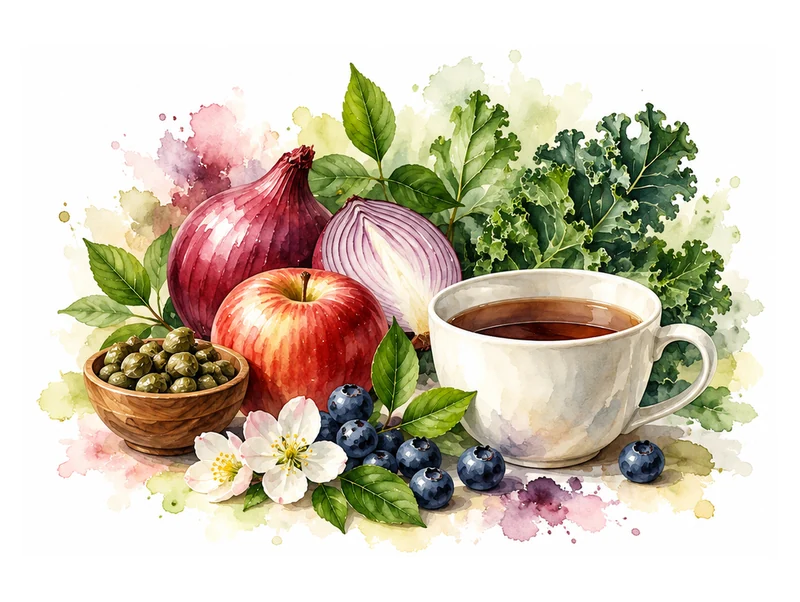
Try the food explorer Watercolor illustration from the book: red onions, an apple, capers, leafy greens, blueberries, and tea.
Start with the scienceHow polyphenols work

What makes a compound a polyphenol? The opening chapters introduce the chemical families, their biological mechanisms, and what happens after you eat them.

Explore absorption, how compounds enter the body, and metabolism, how the body and gut microbes change them.

Foundational chapters 1–4

Meet the compounds50 profiles + 450 concise entries

Look up familiar names such as quercetin, resveratrol, and curcumin. The detailed profiles connect chemical identity, food sources, and research context.

The additional catalogue helps you explore hundreds more polyphenols and related plant compounds, with a compound index for finding your way.

In-depth profiles and Section 3: 450 Additional Compound Entries

Read from the quercetin profile
Step into the kitchenCooking, storage, and food choices

Consider how cooking, processing, and storage affect food composition. Explore a color-coded food guide, pantry staples, and a seven-day plant-diverse meal plan with a shopping list.

The emphasis is on particular foods and preparations, with attention to variation and gaps in the data.

Section 4: The Polyphenol Kitchen

Read a passage from this section
Put health research in contextWhat a study can and cannot tell us

Read about research on cardiovascular, brain, gut, joint, skin, and other health topics alongside its study limitations.

Laboratory experiments, animal studies, and studies in people answer different questions. The book keeps those distinctions visible, and separates findings about foods, extracts, mixtures, and isolated compounds.

Section 5: Polyphenols for Common Health Goals

Look closer at skincareIngredients, formulations, and evidence

Explore oral and topical preparations, formulation, stability, and the research behind ingredient claims.

A study of a particular preparation does not establish the same effects for every product containing that ingredient. The section helps readers keep the formulation and evidence in view.

Section 6: Polyphenols in Skincare

Keep exploringIllustrations, glossary, and references

Use 20 illustrations, a glossary, a compound index, and a consolidated bibliography to move from an unfamiliar term to a deeper understanding.

Read from the beginning for the foundations, or return to a topic whenever a new question comes up.

Reference tools throughout the book

Read the opening guide

A closer look at everyday foods

What’s in your food?

Choose a food. Meet a few of its plant compounds, and discover why the details matter.

Brewed green tea

Green tea

Green tea contains a family of related polyphenols called catechins, including EGCG, EGC, and ECG.

Example compounds

  • (-)-Epigallocatechin-3-gallate (EGCG)Flavan-3-ol (catechin)
  • (-)-Epigallocatechin (EGC)Flavan-3-ol (catechin)
  • (-)-Epicatechin-3-gallate (ECG)Flavan-3-ol (catechin)

A little context

Tea samples and brewing conditions differ, so these examples do not describe a fixed amount in every cup.

Sources for this food
  1. Analysis of some selected catechins and caffeine in green tea by high performance liquid chromatography (2012)
  2. Comprehensive Investigation of the Effects of Brewing Conditions in Sample Preparation of Green Tea Infusions (2019)

Brewed coffee

Coffee

Coffee contains several caffeoylquinic acids, members of the wider chlorogenic acid family.

Example compounds

  • 3-O-Caffeoylquinic acid (3-CQA)Hydroxycinnamate ester (chlorogenic acid)
  • 4-O-Caffeoylquinic acid (4-CQA)Hydroxycinnamate ester (chlorogenic acid)
  • 5-O-Caffeoylquinic acid (5-CQA)Hydroxycinnamate ester (chlorogenic acid)

A little context

Roasting and brewing change the composition, so one coffee does not represent every cup.

Sources for this food
  1. Quantification of Caffeoylquinic Acids in Coffee Brews by HPLC-DAD (2014)
  2. Effect of roasting on the formation of chlorogenic acid lactones in coffee (2005)
  3. In vitro antioxidative effects and tyrosinase inhibitory activities of seven hydroxycinnamoyl derivatives in green coffee beans (2004)

Cocoa powder and cocoa products

Cocoa

Cocoa contains individual flavan-3-ols and linked compounds called procyanidins. Procyanidin B2 is a two-unit example.

Example compounds

  • (-)-EpicatechinFlavan-3-ol
  • (+)-CatechinFlavan-3-ol
  • Procyanidin B2Proanthocyanidin (procyanidin dimer)

A little context

Processing, including roasting and alkalization, changes the polyphenol profile. Cocoa products are not chemically interchangeable.

Sources for this food
  1. Analyses of polyphenols in cacao liquor, cocoa, and chocolate by normal-phase and reversed-phase HPLC (2000)
  2. (-)-Catechin in Cocoa and Chocolate: Occurence and Analysis of an Atypical Flavan-3-ol Enantiomer (2007)

Blueberry fruit

Blueberry

Blueberries contain anthocyanin pigments alongside other polyphenols, including flavonol glycosides and phenolic acids.

Example compounds

  • Malvidin-3-O-glucosideAnthocyanin
  • Quercetin-3-O-galactosideFlavonol glycoside
  • Chlorogenic acidHydroxycinnamate ester

A little context

The mixture varies with blueberry type and ripeness. These examples are not a health score or a complete ingredient list.

Sources for this food
  1. Diversity in Metabolites and Fruit Quality Traits in Blueberry Enables Ploidy and Species Differentiation and Establishes a Strategy for Future Genetic Studies (2020)
  2. Characterization of Changes in Polyphenols, Antioxidant Capacity and Physico-Chemical Parameters during Lowbush Blueberry Fruit Ripening (2013)

Extra virgin olive oil

Extra virgin olive oil

Extra virgin olive oil contains several families of phenolic compounds, including phenolic alcohols and secoiridoid derivatives.

Example compounds

  • HydroxytyrosolPhenolic alcohol
  • OleaceinSecoiridoid derivative
  • OleocanthalSecoiridoid derivative

A little context

Storage conditions can change the phenolic profile. These examples do not guarantee the composition of a particular bottle.

Sources for this food
  1. Content Variations in Oleocanthalic Acid and Other Phenolic Compounds in Extra-Virgin Olive Oil during Storage (2022)

Apple peel and flesh

Apple

Apple peel and flesh contain phenolic acids, flavan-3-ols, and dihydrochalcones; phloridzin is also called phloretin 2′-glucoside.

Example compounds

  • Chlorogenic acidHydroxycinnamate ester
  • EpicatechinFlavan-3-ol
  • PhloridzinDihydrochalcone glycoside

A little context

Peel, flesh, and apple varieties have different profiles. These examples do not specify the composition of every apple product.

Sources for this food
  1. The Behavior of Phenolic Compounds from Apples during Simulated Gastrointestinal Digestion with Focus on Chlorogenic Acid (2024)
  2. Electroactive Phenolic Contributors and Antioxidant Capacity of Flesh and Peel of 11 Apple Cultivars Measured by Cyclic Voltammetry and HPLC–DAD–MS/MS (2020)

Onion bulb

Onion

Onions contain quercetin attached to sugars, including mono- and diglucoside forms in the flavonol family.

Example compounds

  • Quercetin 3,4′-O-diglucosideFlavonol glycoside
  • Quercetin 4′-O-glucosideFlavonol glycoside

A little context

White, yellow, and red onion samples have different flavonol profiles. These examples are not a ranking of onion varieties.

Sources for this food
  1. Development of a Rapid UHPLC-PDA Method for the Simultaneous Quantification of Flavonol Contents in Onions (Allium cepa L.) (2021)

Sweet orange (Citrus sinensis)

Orange

Sweet oranges contain flavanone glycosides such as hesperidin and narirutin, both carrying a rutinose sugar group.

Example compounds

  • HesperidinFlavanone glycoside
  • NarirutinFlavanone glycoside

A little context

This profile concerns sweet orange. Other citrus species and different parts of the fruit have distinct profiles.

Sources for this food
  1. Survey of Phenolic Compounds Produced in Citrus (1998)

Read a little. Discover more.

Open the book.

A familiar food, a compound profile, a place to begin. Browse three short excerpts in the author’s own words.

Read more on Amazon

Choose “Read sample” on the book listing.

The Polyphenol Kitchen

Cooking Methods and Polyphenol Retention

Cooking changes a food’s texture, flavor and chemical composition. Some phenolics move into the cooking liquid; some break down or change form; others become easier to extract from softened tissue. These processes can occur together. The useful question is how a particular food and compound respond to a particular preparation, rather than which appliance always preserves a fixed percentage.

From The Encyclopedia of Polyphenols

A closer look at a compound

Quercetin: How to Get More

Food composition depends on the food and its preparation. USDA Release 3.3 reports mean quercetin values as aglycone equivalents per 100 g edible portion: canned capers 172.55 mg, raw capers 233.84 mg, raw red onions 39.21 mg, raw kale 22.58 mg and raw spinach 3.97 mg. A weighed 9 g portion of canned capers corresponds to about 15.53 mg on that database basis; the record does not quantify a rinsed portion separately. These are aggregated composition values, with substantial sample variation, not a guaranteed amount in every serving. Use the matching cooked-food record when estimating a cooked dish; the raw values do not establish how much a particular cooking method retains (USDA, 2018).

From The Encyclopedia of Polyphenols

A reference and a learning resource

How to Use This Encyclopedia

This Encyclopedia is designed as both a reference work and a learning resource. This section orients readers to its structure and offers guidance on how to navigate and apply the information.

From The Encyclopedia of Polyphenols

Short selections from the book. The complete chapters provide further context and references.

About the author

Research,
made accessible.

A research background in plant phenolics and their interactions with iron.

Jeffrey E. de Graft-Johnson, MD, PhD, is a physician-scientist and the author of The Encyclopedia of Polyphenols. His doctoral research examined the antioxidant and pro-oxidant activity of plant phenolics, including how these compounds interact with iron in reactions that can contribute to oxidative damage.

He wrote The Encyclopedia of Polyphenols to make a wide and often scattered body of research more accessible. The book brings together 500 entries on polyphenols and related plant compounds, exploring their food sources, absorption, metabolism, and potential relevance to health.

Combining clear explanations with practical context, the encyclopedia distinguishes laboratory and animal findings from evidence in people. It helps readers explore the science behind familiar foods while understanding both the possibilities and the limitations of research on plant compounds.

Find Jeffrey on LinkedIn

For curious readers

A few useful
questions.

Who is this book for?

Curious general readers, students, and health and nutrition professionals who want to explore plant compounds and read their science with care. The foundational chapters and glossary provide a place to begin when the terminology is new.

Do I need to read it from beginning to end?

No. It is designed as both a reference and a learning resource. Start with the opening chapters for the foundations, or use the compound index to look up a specific name and follow the cross-references.

How does the book handle health claims?

It considers laboratory, animal, and human findings in their study context. A laboratory mechanism is not proof of a benefit in people. Results from foods, extracts, mixtures, and isolated compounds are also kept distinct.

Can it tell me which supplements to take?

The book is an educational reference, not an individualized treatment or supplement plan. It includes discussion of clinical considerations and interactions. Decisions about supplements or medical conditions belong in a conversation with your healthcare professional.

Can I read a sample before choosing an edition?

Yes. You can read the short excerpt above, or visit the Amazon paperback listing and choose “Read sample”. Paperback and Kindle links are provided below, with current purchase details on Amazon.

Bring the curiosity home

Your next food question
starts here.

Explore The Encyclopedia of Polyphenols
in the format that suits the way you read.

PaperbackBrowse the illustrated reference in printKindle editionKeep the reference close at hand

Both links open Amazon. See each listing for current pricing and availability.

Follow the work

Stay connected.

Find Jeffrey’s books and public professional profiles.